



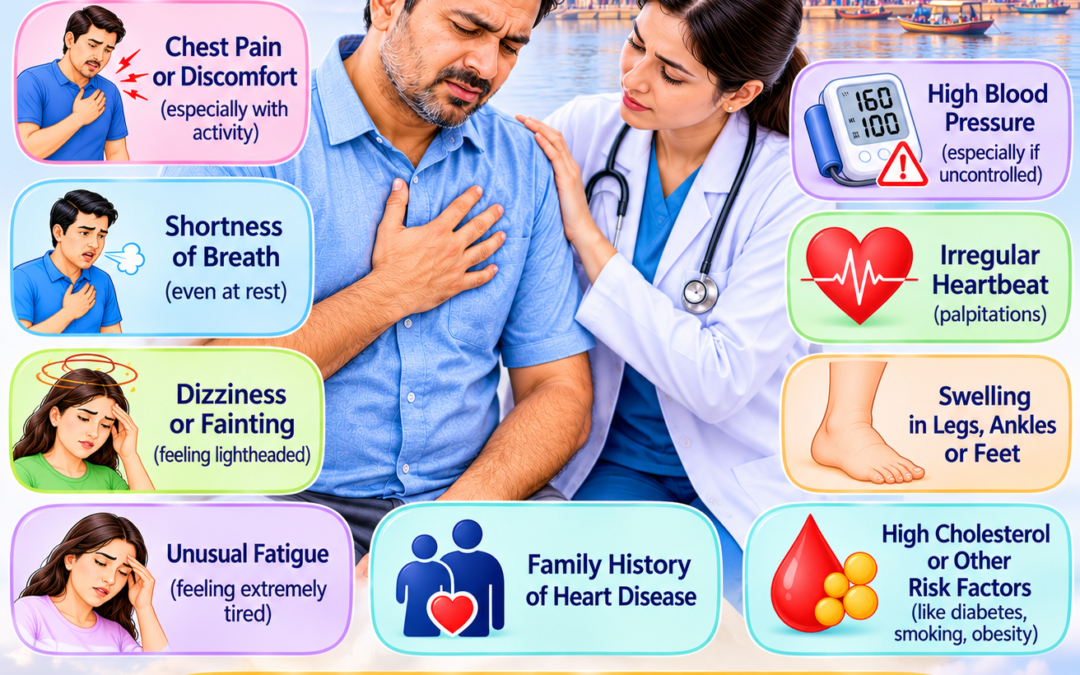
You should see a cardiologist when chest discomfort, breathlessness or palpitations carry on beyond a few days, or when you have risks such as diabetes, high blood pressure or a close relative with early heart disease. There is no need to wait for severe symptoms. An early check often shows a healthy heart, and when it does not, the problem is usually easier to treat.
According to the Medical Oncology Team at KNMH, cancer patients need the same attention. Some chemotherapy drugs and radiation to the chest can weaken the heart over time, so anyone treated in the past should tell the cardiologist at the first visit.
Not sure whether your symptoms need a heart check?
What Are the Signs You Need to See a Cardiologist?
Most of these symptoms have other causes too. The ones that last or keep returning are the ones to get examined.
- Chest Discomfort – A pressure or heaviness in the middle of the chest that appears on walking or climbing stairs and eases with rest is the classic pattern. It sometimes travels to the left arm or the jaw.
- Breathlessness on Exertion – Struggling with a flight of stairs that was easy last year, or waking at night short of breath, needs checking. Many people blame age or weight and wait too long.
- Palpitations or Fainting – A racing or skipping heartbeat, or a faint with no clear reason, may point to a rhythm problem. One brief episode is often harmless, but repeated ones call for an ECG.
- Swollen Feet with Tiredness – Ankles that puff up by evening, together with fatigue out of proportion to the day’s work, can mean the heart is pumping weakly. Either one alone is less worrying than both together.
Chest pain lasting more than ten to fifteen minutes, especially with sweating or pain in the arm or jaw, is an emergency. Go to the nearest hospital instead of waiting for an appointment at the cardiology department.
When to Consult a Cardiologist Even Without Symptoms
Heart disease often builds quietly, so some people should be checked before anything feels wrong.
- Diabetes, High Blood Pressure or High Cholesterol – Each of these damages the blood vessels slowly over the years. A person with two of them should have a yearly ECG and a lipid profile.
- A Family History of Early Heart Disease – A father or brother with a heart attack before 55, or a mother or sister before 65, raises your own risk. Screening in such families often begins around 30 to 35.
- Tobacco, Weight and Inactivity – Smoking or chewing tobacco, a large waistline and little daily activity add up over time. After 40, a heart check is sensible if more than one of these applies.
- Past Cancer Treatment – Patients who have had chemotherapy or chest radiation can develop heart trouble months or even years later. A baseline check, with follow-up afterwards, picks up changes early.
People often search for the best cardiologist in Prayagraj. It is more useful to look at qualifications, experience with your particular condition, and whether the hospital can do an ECG, echocardiogram and stress test with emergency support available.
What Determines the Right Treatment Approach for Heart Problems?
Two patients with chest pain can need very different treatment.
- Pattern of Symptoms – When the discomfort began, what brings it on and what relieves it help separate heart pain from acidity or a pulled muscle. This history often matters more than the first test.
- Test Findings – An ECG, echocardiogram, treadmill test and blood tests show how the heart is working, and an angiogram may follow if a blockage is suspected. Many of these are done through the hospital’s diagnostic departments.
- Other Illnesses and Medicines – Diabetes, kidney disease and the tablets a patient already takes decide what is safe to prescribe. A history of cancer treatment is kept in mind as well.
- Medicines, Procedure or Lifestyle – Many patients do well on tablets with changes in diet and activity, while some need angioplasty or surgery. The choice depends on the findings, the patient’s age and general health.
Key Takeaways
- See a cardiologist when chest discomfort, breathlessness, palpitations or swelling lasts or keeps returning, even if it is mild.
- With diabetes, high blood pressure, high cholesterol, a family history or past cancer treatment, a check-up makes sense before symptoms begin.
- Chest pain beyond ten to fifteen minutes, with sweating or pain in the arm, needs emergency care.
- When choosing a cardiologist, look at qualifications, experience, and the tests and emergency support the hospital offers.
FAQ
When should I see a cardiologist for chest pain?
If it keeps recurring, comes on with effort or lasts more than a few minutes. Severe pain with sweating is an emergency.
Do I need a heart check-up if I feel fine?
Yes, if you have diabetes, high blood pressure, high cholesterol or a family history of early heart disease, or you are past 40 with other risks.
What tests are done at the first visit?
Usually an ECG and a blood pressure check, then an echocardiogram, stress test or blood tests if needed.
How do I choose a good cardiologist?
Check qualifications and experience, and make sure the hospital offers the tests and emergency support you may need.
Reference
- American Heart Association – Warning Signs of a Heart Attack: https://www.heart.org/en/health-topics/heart-attack/warning-signs-of-a-heart-attack
- World Health Organization – Cardiovascular diseases: https://www.who.int/news-room/fact-sheets/detail/cardiovascular-diseases-(cvds)
Disclaimer:
This article is for general education and does not replace advice from a qualified doctor. Please consult a cardiologist before making any decision about your heart health.