


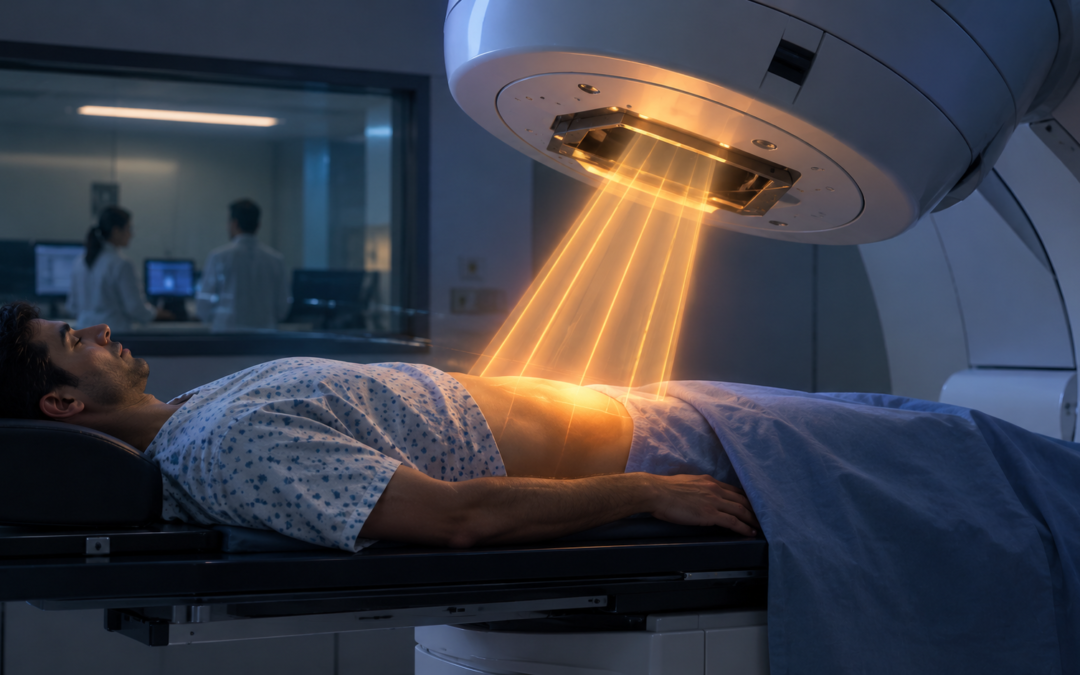
High-energy beams. That’s radiation therapy in one line. Aimed straight at the tumour, calibrated to kill cancer cells while sparing as much healthy tissue around it as physically possible. Comes external, machine outside the body, or internal, source placed right at the tumour site. Sessions run daily, five days a week usually, for weeks at a stretch. Sounds harsh. Isn’t, not in the room. Every beam gets mapped down to the millimetre before it’s ever used.
According to the Medical Oncology Team at KNMH, radiation therapy isn’t one-size treatment, the dose and angle get planned fresh for every single patient’s anatomy. Same cancer, different body, different plan.
Not sure if radiation’s even the right call for your case?
What Happens Before Radiation Therapy Starts?
Before the first beam even fires, there’s a whole mapping stage. Skip that, and nothing after it works right.
- CT Simulation – Patient lies exactly how they will for every real session, and a CT scan maps the tumour’s precise location, down to the millimetre.
- Custom Moulds – Need to stay still for treatment? A mould or mask gets made, body-specific, so the same position repeats every single time.
- Dose Planning – This is where physicists and oncologists sit together and work out angles, beam strength, session count, all of it mapped on a computer first.
- Marking – Tiny tattoo dots, sometimes just marker. Sounds small. Keeps every session lined up exactly right, week after week.
Get this stage wrong and the whole treatment suffers. That’s why planning at radiation oncology takes days, sometimes longer, before anyone gets treated.
What Happens During and After Radiation Sessions?
Actual treatment day? Quick. Mapping did the hard part already.
- Daily Sessions – Ten, fifteen minutes, most of it just positioning. The beam itself runs for seconds at a time, several angles, one after another.
- No Pain – Feel anything during it? No. Radiation’s painless in the room, it’s the days after where fatigue and skin changes show up.
- Skin Reaction – Redness, dryness, sometimes peeling, right where the beam entered. Sunburn-like. Usually shows up a couple weeks in.
- Follow-Up Scans – Weeks after the last session, imaging checks how the tumour responded. Results don’t show up instantly. That’s just how radiation works.
How much radiation gets used, and for how long, comes straight back to cancer staging done right at diagnosis.
Why Choose KNMH For Cancer Treatment?
Kamala Nehru Memorial Hospital’s had LINAC-based radiation running for years now, external beam, image-guided, the works. Regional Cancer Centre tag since 1994, Government of India.
Same building handles the CT mapping, the planning, the actual sessions. Nobody’s shuttling between centres here. Call 9918802141, get the case looked at.
FAQ
Does radiation therapy hurt during the session?
No, the treatment itself is completely painless in real time.
How long does a full radiation course usually take?
Anywhere from one to eight weeks, depending on the cancer.
Can radiation therapy be combined with chemotherapy?
Yes, many regimens use both together for stronger combined results.
Does radiation therapy affect healthy tissue nearby?
Some exposure happens, but modern planning minimizes it significantly.
Reference
Disclaimer: This blog is for general information only and does not replace professional medical advice; transplant eligibility depends entirely on individual diagnosis and health status.