



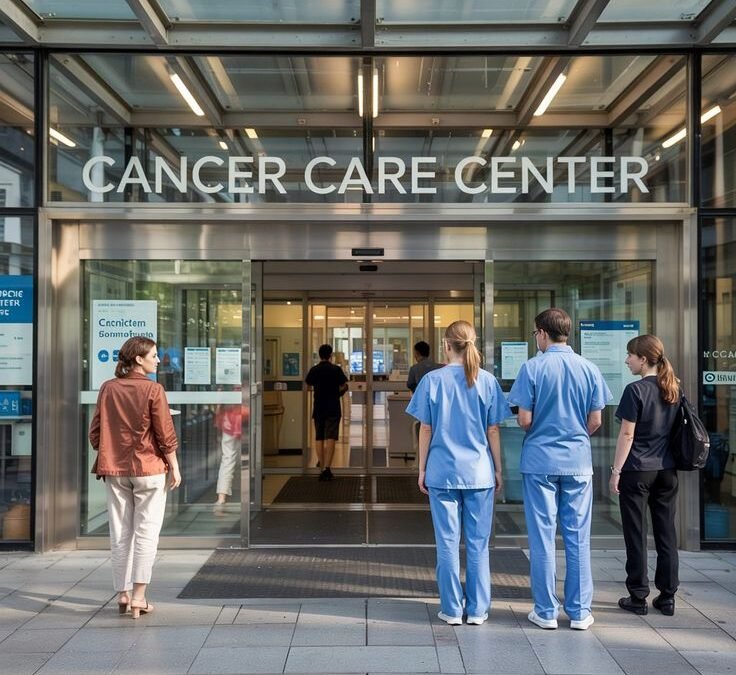
A Regional Cancer Centre (RCC) is a Govt-designated institution under India’s National Cancer Control Programme, formally recognised by the Ministry of Health and Family Welfare to deliver comprehensive cancer diagnosis, treatment, research, palliation, and rehabilitation to a defined geographic region. RCCs meet strict central government benchmarks on infrastructure, staffing, and patient outcomes that most hospitals never qualify for. In Uttar Pradesh, very few hospitals hold this designation. KNMH has held active RCC status since 1994.
According to a Senior Medical Oncologist at KNMH, the best cancer hospital in Prayagraj, “RCC designation isn’t a title a hospital can claim on its own it reflects decades of meeting standards that most facilities in the country have never been required to reach.”
Skip the back-and-forth. Get a complete cancer workup at KNMH’s oncology unit today.
What actually separates an RCC from any other cancer hospital?
Plenty of hospitals in India treat cancer. That’s not the same as being built around it.
- The government assessed the hospital before giving it that tag: RCC status requires a formal evaluation by the Ministry of Health – specialist staffing ratios, radiation therapy infrastructure, surgical oncology capacity, documented patient outcomes over time. Passing that is different from opening a chemotherapy unit and putting oncology on the signboard.
- They run cancer registries that track the whole region: Incidence rates, cancer types, what stage patients arrive at, how treatment plays out – all of this gets recorded systematically at an RCC. That data goes into national cancer policy. A general hospital with an oncology ward isn’t doing any of this.
- Clinical research and training aren’t optional here: Running trials, training oncology professionals, contributing to epidemiological studies – these are part of what an RCC is required to do. Not a side project. The clinical depth that accumulates from decades of doing this is hard to replicate.
- The catchment area is the whole region, not just the city: KNMH covers patients from across eastern UP. Many of them have nothing comparable within hundreds of kilometres. That’s the reason the designation exists – to make sure those patients have somewhere to go that’s actually equipped.
Before choosing where to get treated, it’s worth checking whether a hospital actually holds RCC designation or just describes itself that way. See what formal cancer treatment departments at KNMH look like when RCC-level infrastructure backs them up.
What does any of this mean for someone who's actually a patient?
The designation is institutional. But it shows up in very specific ways for the person going through treatment.
- Surgery, chemo, and radiation on one campus coordinated: These don’t run as separate departments that occasionally talk. The same tumour board reviews the case, the same file follows the patient, and moving between treatment phases doesn’t mean starting over somewhere new.
- Wards most UP hospitals haven’t built: A dedicated Adult Leukemia and Lymphoma Ward, Paediatric Oncology with its own protocols, and on-campus Bone Marrow Transplant built because an RCC’s patient numbers and clinical mandate justify them. Most regional hospitals haven’t reached that point.
- The system follows the patient, not the reverse: Post-surgery follow-up, mid-chemo reviews, post-radiation checks all tracked in-house. No chasing your own records or reminding the team which phase you’re in.
- Affordable isn’t a scheme here it’s the structure: As KNMH Trust, KNMH is not-for-profit and centrally recognised. Cancer treatment here isn’t discounted from a private rate; it’s built around what patients in eastern UP can actually sustain across a full course.
Choosing between a hospital that treats cancer and one that was specifically built and assessed to treat it – that choice has real consequences for how treatment goes. Most patients only find that out after they’ve already started somewhere.
Why Choose Kamala Nehru Memorial Hospital ?
Founded by Mahatma Gandhi in 1941, NABH-accredited KNMH Prayagraj – Kamala Nehru Memorial Hospital – is a not-for-profit RCC recognised by the Government of India since 1994. Over 1.68 lakh patients a year, 400 beds, 20+ specialties including BMT, Paediatric Oncology, Nuclear Medicine, and a dedicated Tumour Board.
FAQ
What is a Regional Cancer Centre in India?
An RCC is a Govt-designated hospital under the National Cancer Control Programme for comprehensive cancer care in a defined region.
How is an RCC different from a private cancer hospital?
RCCs meet strict government benchmarks for staffing, infrastructure, and outcomes that private hospitals aren’t required to meet.
Is KNMH a government-recognised Regional Cancer Centre?
Yes, KNMH has been a Government of India-recognised Regional Cancer Centre since 1994.
Does RCC designation mean treatment is more affordable?
Yes, RCCs are not-for-profit institutions where cancer treatment is subsidised for underserved patient populations.